
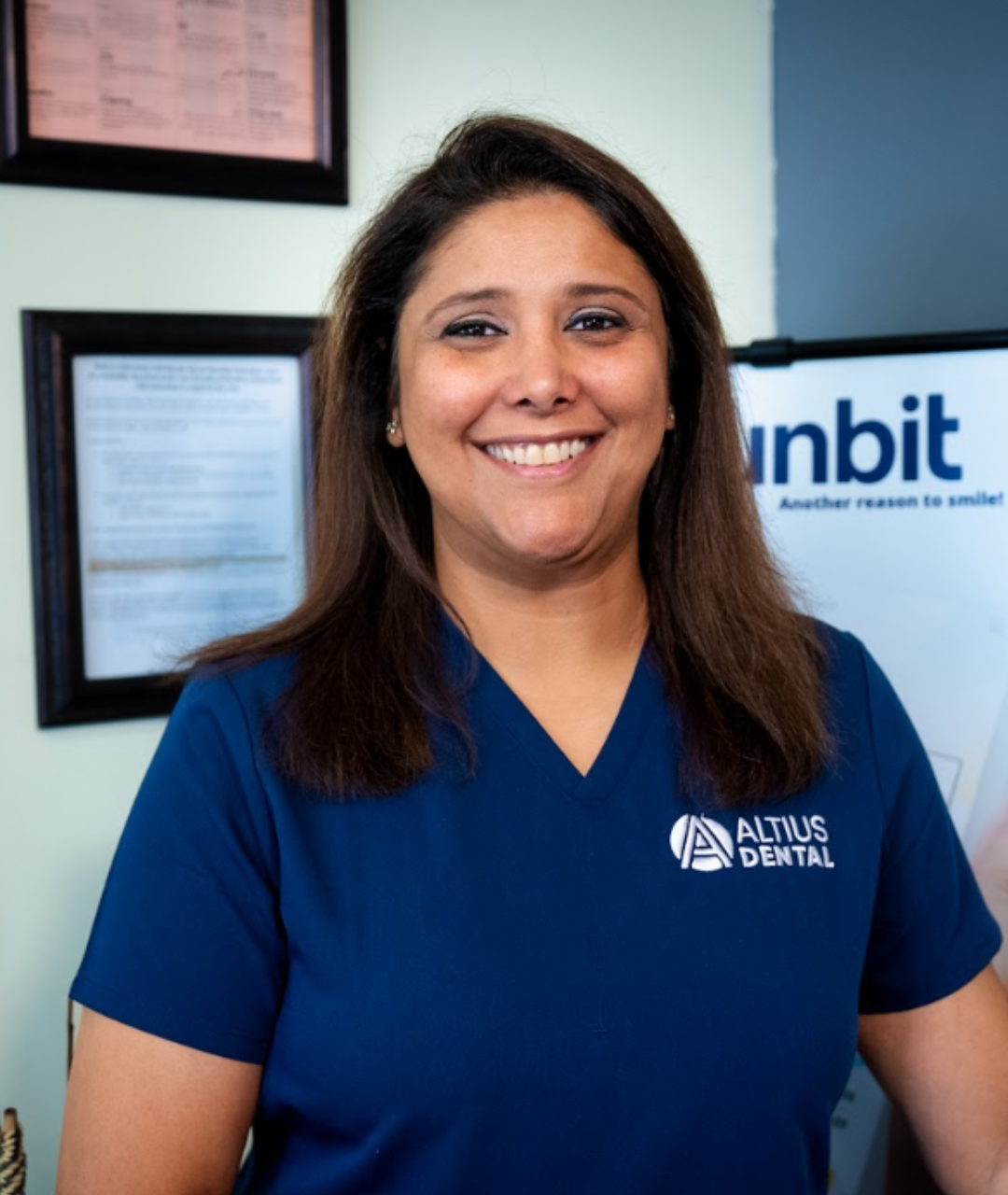
Dr. Gunjan Dhir’s Research on Denture Materials and Candida Resistance
Evidence First Denture Care at Dental World in Alice, Texas
Dr. Gunjan Dhir, BDS, MS, is a prosthodontist and co-founder of Altius Dental, the group behind Dental World in Alice, Texas. Her published research studied denture materials designed to resist the yeast behind most denture infections, without giving up the strength a real denture needs.

PUBLISHED RESEARCH
Peer reviewed denture studies

YEAST RESISTANT FOCUS
Materials that discourage Candida

STRENGTH KEPT INTACT
Impact and fracture tested

2611 E Main St Ste 401,
Alice, TX 78332
 CLICK TO CALL NOW(361) 396-4952
HOURS:
Monday to Friday
9:00am to 5:00pm
Dr. Gunjan Dhir’s Research on Candida-Resistant Denture Materials
- Dr. Gunjan Dhir is a prosthodontist and co-founder of Altius Dental, the group behind Dental World in Alice, Texas.
- Her research explored adding a charged ingredient, phosphate, to denture acrylic to discourage Candida, the yeast behind denture stomatitis.
- A 2008 laboratory study she co-authored found that adding phosphate to denture acrylic did not significantly change impact strength, fracture toughness, or bonding to artificial teeth, while increasing the material’s hydrophilicity.
- Day to day denture care at Dental World is provided by Dr. Chaitra Arakere, DMD. You can explore options on our dental services page.
- Dental World is a 4.7 star dental office in Alice, Texas, with more than 440 Google reviews.


440+ Google Reviews

PROSTHODONTIST RESEARCH
Published denture studies

GENTLE DENTURE CARE
Calm, judgment free

EXPERT CLINICAL CARE
Dr. Chaitra Arakere, DMD
Who Is Dr. Gunjan Dhir?
Dr. Gunjan Dhir is a prosthodontist, co-founder, and Chief Dental Officer of Altius Dental, the group behind Dental World. Her prosthodontic training focuses on replacing missing teeth with dentures, bridges, and implants. She also co-founded Smile Savers Dental Solutions, alongside Dr. Gaurav Puri, to help make implant and full-mouth restorative care more accessible to rural and underserved Texas communities. Her published research on denture materials and Candida resistance reflects the same focus on improving long-term restorative care.
Beyond the clinic, Dr. Gunjan Dhir is a published dental researcher whose work looked closely at the material a denture is made of, not just the teeth on the front of it. You can read her full profile on the Altius Dental leadership page.
Why Denture Materials Matter ?
Dentures attract yeast because their surface gives it an easy place to settle. Most dentures are made from an acrylic called PMMA, which is comfortable and natural looking, but a common yeast, Candida albicans, takes hold on it readily. That is the cause of denture stomatitis, a red and sometimes tender patch under the denture, usually on the roof of the mouth. Because it often does not hurt, many people do not notice it until a checkup.
The frustrating part is how it keeps returning. Your natural teeth wear a thin film of saliva that carries the mouth’s own defense proteins, which help keep microbes in balance. Denture acrylic does not attract that protective film nearly as well, so the covered underside of a denture becomes easy ground for yeast to build a sticky film. Antifungal medicine can knock the yeast back, but if the denture surface keeps holding that film, the infection simply returns. The yeast lives on the denture, not only in the mouth.
Dr. Gunjan Dhir’s Research on Candida-Resistant Dentures
Instead of treating the same infection again and again, the researchers asked a smarter question. What if the denture material itself could be made unwelcoming to yeast? Denture acrylic does not hold the mouth’s protective proteins well, partly because it lacks a certain negative electrical charge. So the idea was to add that charge back by blending a small amount of a phosphate containing ingredient into the acrylic. Think of it as giving the denture surface the same grip for the body’s natural defenses that real teeth have.
The catch is that a denture cannot only resist yeast. It still has to survive a drop onto a hard floor, resist cracks through years of chewing, keep its color, and hold its false teeth firmly in place. Improve one thing and damage another, and you have solved nothing. That tension is what the research had to resolve.
What the 2008 Study Found
Published in the Journal of Prosthetic Dentistry, the study co-authored by Dr. Gunjan Dhir examined phosphate-containing denture resins and evaluated their impact strength, fracture toughness, surface wettability, and bonding ability. The researchers found no significant adverse differences in the tested physical and mechanical properties compared with the control resin, while increasing phosphate concentrations made the material more hydrophilic.
Read the full research paper: Effect of phosphate group addition on the properties of denture base resins — PubMed
At the same time, the surface did exactly what it was supposed to. As more phosphate went in, the material grew more water friendly, and that matters because Candida clings more readily to water repelling surfaces than to water loving ones. A more water friendly denture is a less inviting home for yeast. The researchers were also clear that this is early, proof of concept work that still needs biocompatibility and clinical testing before such a material reaches patients. That honesty is a mark of good science.
What This Means for Denture Patients
For patients in Alice, the practical lesson is that a denture is only as healthy as the material and the fit working together, and that is the standard behind denture care at Dental World. Day to day care here is led by Dr. Chaitra Arakere, who brings more than 23 years of experience in comprehensive cosmetic and family dentistry and holds a Doctor of Dental Medicine from Nova Southeastern University College of Dental Medicine. A Captain in the Texas Air National Guard, Dr. Arakere is known for a gentle touch and a patients first approach. The Alice community has noticed, giving Dental World a rating of 4.7 stars across more than 440 Google reviews. Dr. Gunjan Dhir’s work extends beyond denture materials research. Through Smile Savers Dental Solutions, which she co-founded with Dr. Gaurav Puri, she also helped develop an approach to making implant and full-mouth restorative care more accessible to rural and underserved Texas communities.
Until a yeast resisting denture exists on the market, the best defenses are the ones already in your hands:
- Clean your denture every day, including the underside that rests against your gums, where the film hides.
- Take it out overnight when your dentist says it is safe, so the tissue can breathe and the acrylic can dry.
- Care for the mouth itself too, gently brushing your gums, tongue, and palate even with no natural teeth left.
- Treat new soreness, redness, or a looser fit as a reason to call, because this problem rarely announces itself with pain.
Frequently Asked Questions (FAQ)
Who is Dr. Gunjan Dhir?
Dr. Gunjan Dhir is a prosthodontist and the co-founder and Chief Dental Officer of Altius Dental, the group behind Dental World. She is also a published dental researcher whose work focused on denture materials designed to resist yeast.
What did Dr. Gunjan Dhir's 2008 denture study find?
Co-authored by Dr. Gunjan Dhir and published in the Journal of Prosthetic Dentistry, the study found that adding a phosphate group to denture acrylic to help resist yeast did not significantly reduce the material’s impact strength, fracture toughness, or its ability to bond the denture teeth in place, while making the surface more water friendly.
Does a yeast resistant denture break more easily?
Based on this research, no. The modified material performed comparably to standard denture acrylic in the strength and durability tests that matter for everyday use.
What is denture stomatitis?
Denture stomatitis is a red and sometimes tender patch that forms under a denture, usually on the roof of the mouth. It is caused by the yeast Candida albicans building up on the denture surface, and it is often painless, so many people do not notice it until a checkup.
Why does my denture infection keep coming back?
Because the yeast lives on the denture surface, not only in your mouth. Medicine alone is often not enough if the denture keeps holding the film. Cleaning it daily, removing it overnight when your dentist advises, and correcting a poor fit all help break the cycle.
Does Dr. Gunjan Dhir treat patients at Dental World?
Her role is as a prosthodontist and co-founder of Altius Dental. Day to day care at Dental World in Alice is provided by Dr. Chaitra Arakere and the team.
Can I get a yeast resistant denture right now?
Not yet as a finished product. The research is promising but still at the proof of concept stage and needs further clinical study. For now, a proper fit, daily cleaning, and regular checkups are the most effective ways to control denture related yeast.
How do I keep my dentures from trapping yeast?
Clean the denture every day including the underside, take it out overnight when your dentist says it is safe, brush your gums and palate, and have a loose or rubbing denture relined promptly. A well fitting, clean denture is the least inviting home for yeast.
Have questions about your dentures in Alice, Texas? Contact Dental World or book your visit now.
